 Skip to content
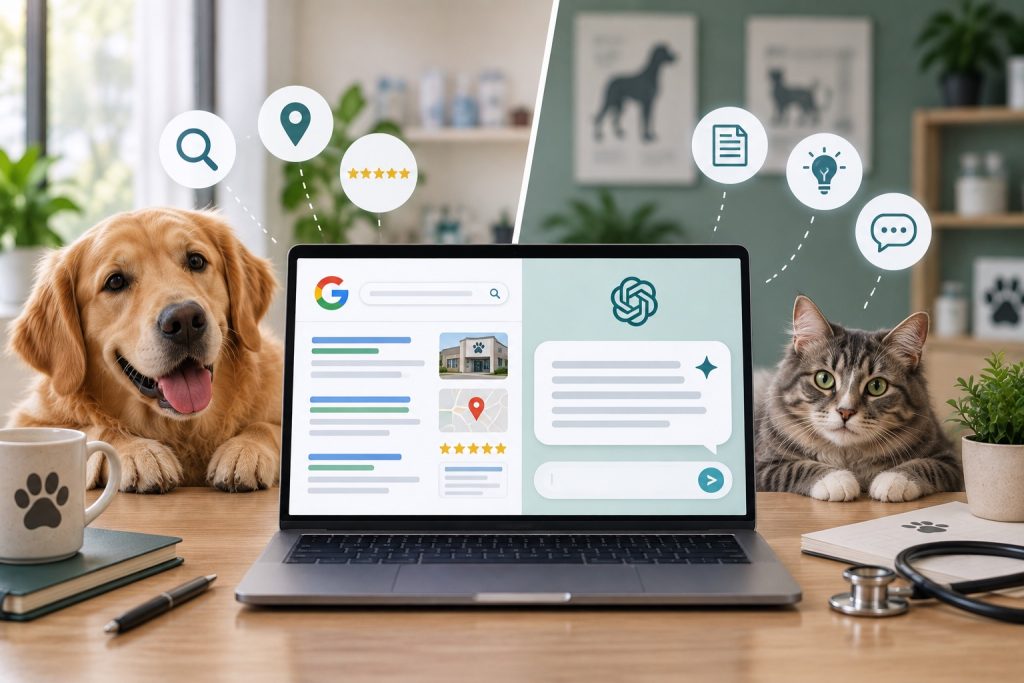
SEO vs AEO for veterinary practices comes down to two related but different goals. SEO helps your practice rank prominently in traditional search results, while AEO helps make your practice’s information understandable and discoverable within AI-generated answers.
Here’s a clear breakdown of how each works, where they overlap, and why veterinary practices increasingly need to think about both.
What Traditional SEO Does
Traditional SEO is built around ranking in the list of results a search engine returns for a given query. It relies on a well-established set of factors: relevant keywords used naturally throughout your site, a strong technical foundation like fast page speed and mobile usability, backlinks from other reputable websites, and content that thoroughly covers topics people search for.
When it works, SEO gets your practice into the mix of options someone sees and can click through to compare. You’re still competing with several other results for that click, but you’re at least in the running.
What AEO Does Differently
AEO is built around a different outcome entirely: being the specific answer an AI tool provides directly, often without displaying a list of options at all. When someone asks ChatGPT or Gemini a question like “what’s a good vet near me,” the AI synthesizes an answer from whatever sources it trusts most, and frequently names one or two specific practices directly.
This relies on different underlying factors than traditional SEO: clear, structured content that directly answers real questions, consistent factual information about your practice across every source (your website, your Google profile, directories), and structured data that removes any ambiguity about what your practice offers.
SEO vs AEO: A Simple Way to Understand the Difference
Traditional SEO gets you a seat in the room, one of several options someone will compare. AEO gets you a name mentioned directly, sometimes as the only option offered. Both matter, because pet owners are using both types of search right now, often without even thinking about which one they’re using in the moment.
Why One Without the Other Leaves a Real Gap
A practice with strong traditional SEO but no AEO strategy might rank well on a standard Google search, while remaining essentially invisible when the same person asks an AI assistant the same underlying question. A practice with strong AEO but weak traditional SEO might occasionally get mentioned by an AI tool, while missing out on the significant volume of pet owners still running conventional searches and comparing several options themselves.
Neither gap is small. Both types of search are actively used today, and the split between them continues to shift.
Where the Two Actually Overlap
It’s worth being clear that SEO and AEO aren’t opposites, and much of the underlying groundwork supports both. A fast, well-structured website with accurate, detailed content helps both disciplines. Consistent business information across your web presence helps both. In practice, a mature strategy builds a strong technical and content foundation, then layers in the specific tactics that separately optimize for traditional rankings and for AI-generated answers.
The Honest Reality Right Now
Most veterinary marketing agencies today are still built almost entirely around traditional SEO, treating AEO, if they address it at all, as a minor addition rather than a core strategy. That’s changing, but slowly, which means practices that invest seriously in AEO now have a real opportunity to establish visibility before this space becomes as competitive as traditional search already is.
At The Vet Marketing Firm, we build both disciplines together from the start, rather than treating AEO as an afterthought layered onto an existing SEO plan. If you’re unsure where your practice currently stands on either front, our free AI Search Score audit gives you a clear picture of both.