 Skip to content
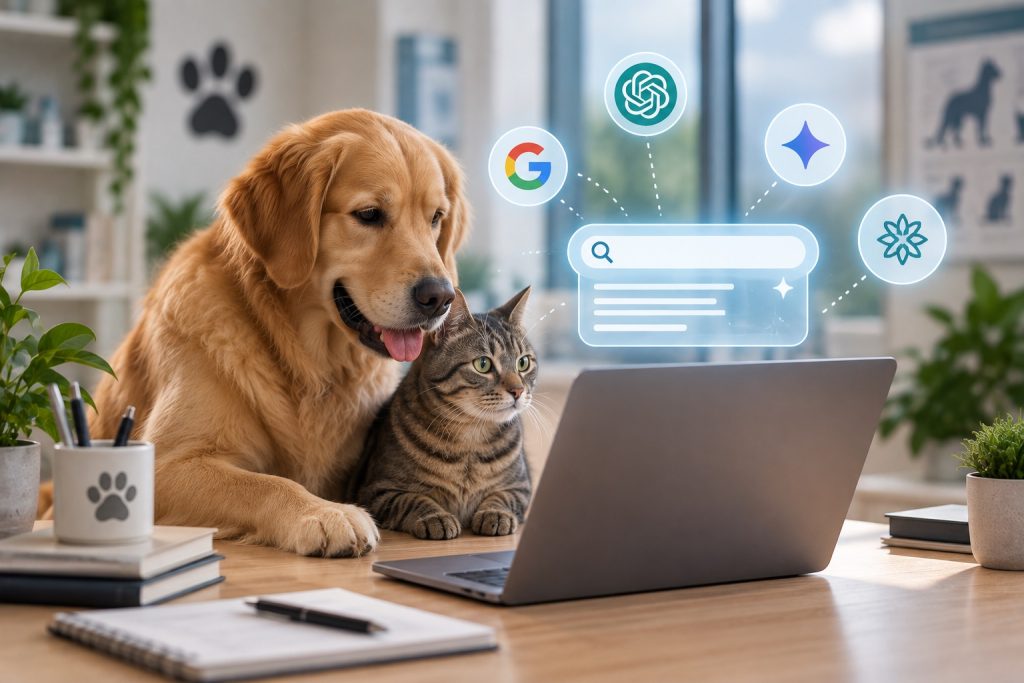
AEO for veterinary practices, or Answer Engine Optimization, is the practice of structuring your website and content so AI tools like ChatGPT, Google’s AI Overviews, Gemini, and Perplexity can understand your practice well enough to surface it in relevant answers, rather than simply relying on traditional search results.
It’s a meaningfully different discipline from traditional SEO, and it matters more for veterinary practices as AI-assisted search becomes more common.
A Real Example Makes This Concrete
Imagine a pet owner in your area types this into ChatGPT: “What’s a good emergency vet near me that’s open right now?” The AI doesn’t return a list of ten links the way Google traditionally has. It gives a direct answer, often naming one or two specific practices by name, pulled from whatever it can determine about local options with strong information and trust signals.
If your practice isn’t part of that answer, you’re not just ranked lower. In many cases, you’re not part of the conversation at all. There’s no page two to eventually be found on.
How This Differs From Traditional SEO
Traditional SEO optimizes to rank well in a list of search results. It relies heavily on keywords, backlinks, page authority, and technical factors like site speed. The goal is earning a click among several competing options a person will scan through.
AEO optimizes to be the answer itself, the specific sentence or paragraph an AI model reads, synthesizes, and repeats back to someone asking a question. It relies on clear, structured information: consistent facts about your practice across your website and directories, content formatted as direct answers to real questions, and structured data (schema markup) that hands AI tools your practice details without requiring interpretation.
These aren’t competing strategies. They work together, but they require genuinely different tactical choices, and a website built only with traditional SEO in mind often performs poorly in AI search, even with strong rankings elsewhere.
Why AEO for Veterinary Practices Matters
Pet owners frequently research in moments of real urgency or worry: a sick pet, an unfamiliar symptom, a move to a new city with no established vet yet. These are exactly the kinds of situations where someone is increasingly likely to ask an AI assistant directly, rather than typing a traditional search query and sifting through results themselves.
Veterinary decisions also involve a meaningful trust component. A pet owner isn’t just looking for the closest option, they’re evaluating who they feel comfortable trusting with a family member. AI tools are increasingly positioned as a trusted first stop for exactly this kind of decision, which makes AEO a genuine trust and visibility issue for practices, not just a technical marketing detail.
What Actually Goes Into Strong AEO
A few concrete things matter most. Your practice’s core facts, name, hours, location, services, need to be identical across your website, your Google Business Profile, and any directories you’re listed on; inconsistency undermines the confidence AI tools place in citing you. Your website content should directly and clearly answer the specific questions pet owners actually ask, formatted with clear headers so both AI tools and human readers can extract the answer quickly. And structured data, schema markup specifically, should be implemented so search engines and AI tools can read your practice’s information without ambiguity.
The Honest State of the Industry Right Now
Most marketing agencies, including many veterinary-specific ones, are still building their strategies almost entirely around traditional SEO. AEO is new enough that a meaningful head start is still available to practices willing to invest in it now, before it becomes as competitive and saturated as traditional search rankings already are.
For practices investing in AEO for veterinary practices now, the goal is to establish clear, authoritative signals before AI-driven discovery becomes even more competitive.
At The Vet Marketing Firm, AEO isn’t an add-on we bolted onto an existing SEO service. We built our entire strategy around the reality that search has already changed, and we structure every website, page, and piece of content we create with AI visibility in mind from the very beginning.